
Frivolous lawsuits. Disgruntled HOA boards. City ordinances. Fire Marshall inspections. Entitled neighbors.
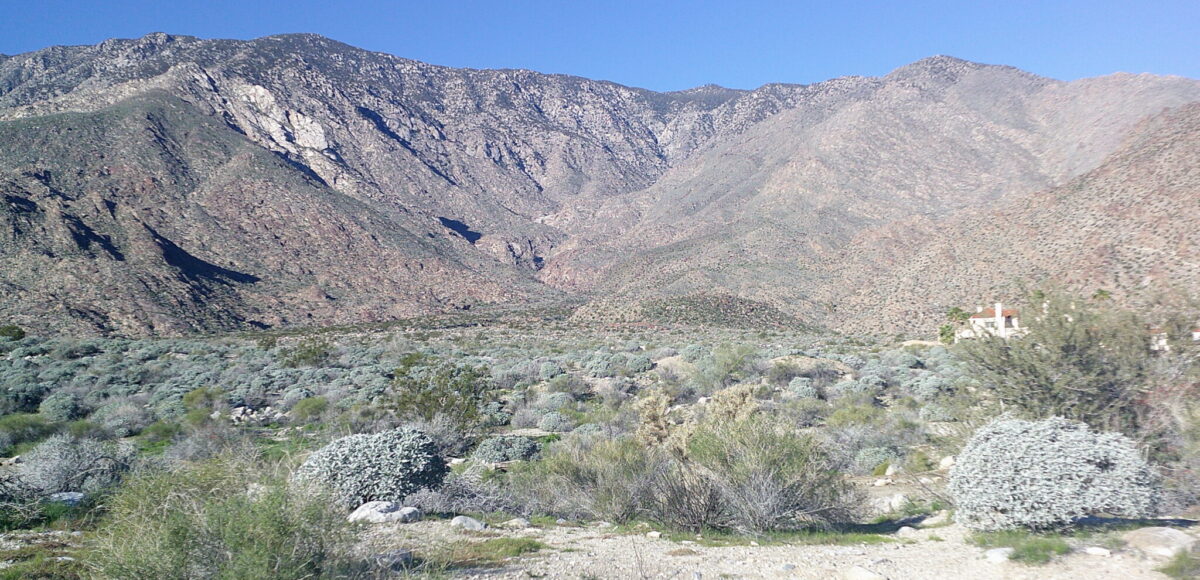
This is just a short list of the unexpected roadblocks I have encountered while working at Oswit Land Trust in my hometown of Palm Springs, CA. Before beginning my co-op internship, I thought the primary issues working at a nature preserve would be picking up litter, plucking out invasive weeds, and telling people they can’t bring their dogs on the trail; however, this urban preserve faces a host of obstacles by virtue of being smack-dab in the middle of a city of 40,000+ seasonal and year-round residents. Luckily, it’s not all code compliance and putting out fires (more on that later). Working at OLT has taught me what being a good neighbor means, and how important building community is, regardless of where you are or how long you might be there.
Oswit Land Trust began in 2016 when founder, Jane Garrison, learned that one of her favorite places to hike, Oswit Canyon, had been bought by luxury home developers, and that this critical habitat of endangered flora and fauna was going to be destroyed. Over the next few years, Jane and fellow community members banded together to raise awareness and the funds necessary to purchase the land from the developers, and successfully saved the land in 2020. Over the following 6 years, OLT has purchased over 8 properties for the mission of “Saving Wildlife One Acre at a Time”. OLT properties are home to thousands of species, including peninsular bighorn sheep, migratory birds, and the endemic Casey’s June Beetle. Without their tireless efforts, much more of the Coachella Valley’s desert landscape would be lost to luxury condos and golf courses.
My day to day tasks are what OLT considers “Crew” work. This is the manual labor arm of the organization, and is really just glorified landscaping. Much of these crew tasks take place at OLT’s Prescott Preserve, a former golf course that was purchased and donated to OLT to be restored to wildlife habitat. After the rains we received in the month of December, invasive London Rocket Mustard (Sisymbrium irio) crept across nearly all 120 acres at a rapid pace. Prescott is abutted by multiple condo associations and thus needs to comply with city codes and reduce fire risk. This includes removing any weeds over 6 inches from within 30 feet of condos and 10 feet of sidewalks. Many early mornings had me outside fighting against this mustard with electric mowers, weed-whackers, or good old-fashioned hand-pulling and hula-hoeing. Experiments with herbicides, used by licensed contractors, ultimately proved to be the most effective way of eliminating the mustard. One thing I have learned during my co-op is that it can be easy to have a puritanical view of how to help nature (“chemicals are always bad”, “only natural methods are okay”), but sometimes hard choices need to be made for the benefit of nature in the long run. Mustard seeds remain viable in the soil for 10 years, and you will never be able to manage their spread with manual techniques alone.
Aside from hours of relentless weeding, I have also had the opportunity to work with Jose Mendoza, the restoration biologist for Prescott Preserve and the head of their native plant nursery. With Jose, I have learned how to take cuttings from native plants for propagation, wild seed collection, and the tedium of keeping sensitive desert flora alive for long enough to plant in the preserve to create natural habitat for wildlife. He has also taught me how to make pressings of plants to be used as part of an herbarium and identification key.
In February, a fire broke out at the Palm Oasis ponds at Prescott, burning over 100 palm trees and damaging crucial migratory bird habitat. In the weeks proceeding, myself and over 75 other volunteers came together to clean up the area for hikers and wildlife. While it was believed that the fire was human caused, it was also humans that did everything we could do to rectify it. We don’t have to be down on ourselves and only see mankind as a scourge on the planet, for we have a choice in which to treat our world for the better. We create problems, but we also solve them. That is the constant struggle that we face in our work to help nature overcome all of the problems it faces in its fight to thrive. We have the option to fight alongside it.
It is easy to feel like Sisyphus pushing the boulder up the mountain doing this type of work. You mow the mustard, it comes back a week later. You pick up a hundred palm fronds one week, just for another hundred to fall the next. You tell one hiker their dog isn’t allowed on trail, just for a different one to pop up tomorrow. My primary mentor through my work with OLT is David Paisley, the Outreach Coordinator and Deputy Director. He is the hardest working man I have ever met, and his dry humor and no nonsense attitude has been a joy to witness. His relentless commitment to the work, despite the obstacles and constant nagging coming at him from all directions, has shown me how committed one must be to this work to keep going. But it isn’t just David that inspires me. It’s the countless volunteers that show up bright and early to do the hard work with smiles on their faces. I have the pleasure of working with people that come from all over the world and call Palm Springs their home, for however long they are there. They are my community and make me proud to call this place home.
This work does not end with us. Generations after us will continue pulling mustard and confronting dog-owners. However, in the words of Jana Stanfield, “I cannot do all of the good the world needs, but the world needs all of the good that I can do.” These words, and the beautiful community members I work with everyday, keep me going.