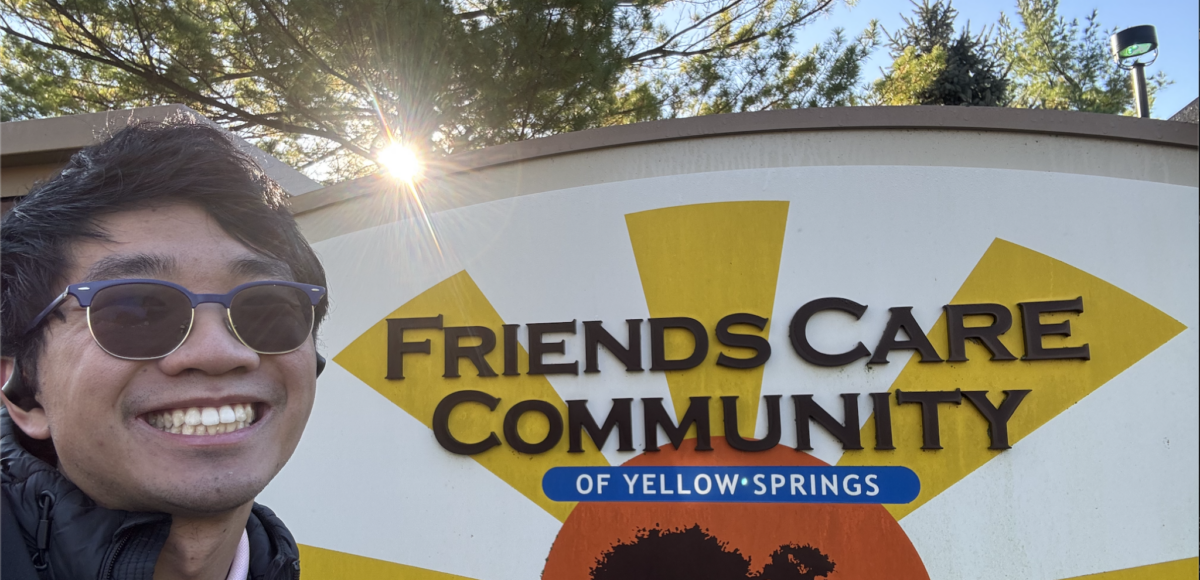

As a senior starting my final Co-op as an Antioch student, I wanted to do something that would balance and, in a way, complete my journey. My last two co-ops were at organizations that focused on non-standardized, mainstream, or traditional methods of care and education for children and adults with cognitive and/or physical disabilities. As such, I wanted this co-op to give me the opportunity to observe and interact with an organization considered a more traditional or standardized institution of care. When I discovered Friends Care Community (FCC), I expected a strict, clinical system of care and organization. However, I could not have been more wrong. While it follows certain standardized practices, I have now come to understand that just because something is standardized doesn’t mean that there isn’t room for character, individuality, and a true drive to meet people where they are and provide care that is truly person-centered.

FFC was founded in August of 1980, initially as a Skilled Nursing Center with 50 beds, and has had a deep history and connection to the town of Yellow Springs, Ohio, having been founded to fill a need in the community and surrounding areas, and continuing to grow with it, always striving to be an example and leader in geriatric and resident care; a prime example being “FCC became the first nursing home in Ohio to admit people with AIDS in May 1987” (“We Have…”, n.d.). And in more recent years, FCC was part of the “less than 1% of all skilled nursing facilities in the United States can state they never had a COVID-positive resident or patient” (“We Have…”, n.d.). As new needs became apparent, FCC strove to fill them. As such, it opened Friends Assisted Living Center in 1999 and Friends Independent Living Cottages in 2002. Lastly, it opened its Short-Term Rehabilitation wing in 2011 (Bachman, 2011), which included Outpatient Rehabilitation. Each facility offers a different type of care structured to meet residents’ needs wherever they are when they come to FCC. However, each service always strives to uphold FCC’s founding Quaker values and mission: “of simplicity, peace, integrity, community, equality, and stewardship, Friends Care endeavors to do right by every individual” (“Who We Are”, n.d.).

Kai answering the phone at FCC
As the evening and weekend front desk receptionist at FCC, my primary responsibilities include answering the phone and connecting callers and visitors to the proper resources, staff, and residents. This primarily involves using the residence listing to connect callers to the appropriate nurse’s station to receive Updates on a specific resident, or to provide room numbers and directions to the room and wing a specific resident is staying in. I also often act as the initial point of contact when someone inquires about moving/utilizingnone of the facilities for themselves or a loved one. As such, I answer any preliminary questions they might have and connect them to the director of clinical admissions. Another form of admission is when another medical facility transfers a resident into our care. As such, I tried to connect them to the proper nursing station. However, if the lines are busy or if no one picks up, I take charge of writing down all necessary medical and personal information for the incoming Residents and reporting it later. My other responsibilities include organizing materials and important files, as well as helping my co-workers with other tasks. My evening shifts on the weekdays can vary drastically from being very quiet to very busy, while my weekend shifts tend to be consistently busy, with me even helping handle events such as memorials on occasion.

Kai organizing CD’s for FCC residents

Kai and Linda
Overall, while my tasks can be generalized, I consistently encounter new scenarios daily, and because my co-worker Linda only works on the weekdays in the morning and afternoons, she was not able to give me a completely clear picture of how to handle certain tasks and responsibilities until I encountered them at least once. Despite it being stressful at times, I would say I have managed to overcome many scenarios on my own. I would say the most challenging part, however, is the fact that I lack the history and rapport with the residents and staff members that others such as Linda have, which sometimes slows or even hinders my ability to connect people to where they need to go, or who to ask for help in certain scenarios. Luckily, my co-workers have all helped me throughout my struggles and guided me to where I need to go.
In the end, despite not primarily working with the residents directly, my biggest takeaway from this co-op will be learning to meet people where they are in life, whether they be a resident in a nursing home or otherwise, because many of the observations I have made while watching my co-workers work, the mandatory training I underwent on standards of care in nursing homes, and HIPAA have shown me that these standards and behavioral practices, while more regulated and implemented more structurally, are all things that can and should be applied in everyday life, such as respecting autonomy and privacy, understanding workplace structures, safety measures, as well as background and statistical informations on the conditions, of a workplace, people You’re going to interact with, because this not only helps the people you are going to work and interact with throughout your life, but also yourself. This is a lesson that will undoubtedly help me as I pursue my current goal of obtaining a master’s degree and a career in clinical mental health counseling (CMHC), as well as my everyday life going forward.
References
Bachman, M. (2011, August 18). Rehab wing opens at Friends Care. The Yellow Springs News.
https://ysnews.com/news/2011/08/rehab-wing-opens-at-friends-care
We have a rich history within the community of Yellow Springs. (n.d.). Friends Care Community.
https://www.friendshealthcare.org/history
Who we are. (n.d.). Friends Care Community. https://www.friendshealthcare.org/about-7