
What is SFMT?
Summer of 2024 I interned at the San Francisco Mime Troupe (SFMT), a touring company, performing political comedy musical theater. The SFMT website shares the mission of SFMT which is “to create and produce theater that presents a working-class analysis of the events that shape our society, that exposes social and economic injustice, that demands revolutionary change on behalf of working people, and to present this analysis before the broadest possible audience with artistry and humor.”
SFMT performs in local parks throughout the Bay Area, sometimes traveling farther North or south of the city. All shows are free or by suggested donation, making shows financially accessible to all. There are devoted SFMT attendees that have been coming to the shows since they were young kids. The props designer herself grew up being amazed by the troupe’s stage magic that she found her way to work with the company as an adult. SFMT is run by a collective, currently of about 10 people, who mostly make decisions by consensus. SFMT strives to embody their “ideals of combating the fragmentation of the working class: we are a democratically run, multi-ethnic, multi-generational, multi-cultural, gender-balanced theater of social justice that by its very existence sustains a vision of community governance of, by, and for the people.” I appreciate SFMT’s striving to embody these practices based on values of community empowerment. I have come to learn that there are power dynamics and ways of doing things that I think could be discussed in more depth that would help strengthen SFMT’s work — as seems the case with most organizations. Nonetheless, it feels like these ideals have set a foundation for principled work and it seems there is space to have these open conversations about what’s working and not working more so than some other places I’ve worked with.
Newcomers and Feedback Processes:
When I first got to SFMT, a couple younger members of the collective encouraged me, as a newcomer, to share ideas and offer feedback on the process on how we do things and the shows itself. Once we got into the first couple weeks, with support from multiple collective members and other younger interns, I was encouraged to send an email to the SFMT Collective with my feedback on how student activism and the narrative around Palestine was being framed. The collective was very appreciative and receptive to my email, and they implemented some changes to the script based on the thoughts I shared. This was really cool to experience and I felt that I, myself, was valued and what I had to say was seriously considered. Though the process was a little bumpy because, even though I was invited to speak, I still didn’t know the limitations of what I was welcome to speak on and I didn’t want to impose myself in this space I was new to. I functioned on the philosophy that I would offer all I had to say, uncensored, written with respect, and I trusted that they would take what they wanted and leave what didn’t work for them. This worked for me in this case. Though I was able to offer feedback, I can see how it is unlikely that other young people new to the collective would feel as empowered to speak up when the limitations are not clear and there may not be enough relationship built with collective members for folks to feel comfortable offering their perspectives. Myself and another intern offered this feedback at the end of the summer reflection session in September.
The content of the summer show and community outreach:
The show itself is called “American Dreams” and it explored the dynamics leading up to the 2024 election, student activism for a Free Palestine, and the future of AI programs. The show seeks to open up the conversations on these issues amongst audience members, to spark critical thought and maybe even mobilize people to get involved in community organizing. In fact, some groups tabled at our events, like the Green Party and other folks registering voters. Community outreach is something that could definitely be strengthened, like getting more community organizations at events. But this has not been something SFMT has been able to prioritize with their budget, time, and people so far.
As for the story, I appreciate that we hold space to recognize the genocide in Palestine, but I also think we could have gone deeper into the dynamics surrounding this issue. I think it is essential to not be silent and to keep bringing our attention to violence and injustice so we can end it. I am proud of us for speaking out. I’m also curious how the mime troupe may be able to explore issues and tell stories that are more deeply connected to grassroots movement and building solutions.
Sound Production:
As for my personal learning, I got to learn about a touring sound system! I became familiar with what plugs into what. I am still grasping why each thing plugs into what.
- Instruments connect to DIs (Direct Inputs) to boost the signal sent to the amplifier that boosts the signal before sending the sound signal to the speakers.
- There are 2 types of ¼ inch cables. We used ¼ to connect the instruments to the DIs:
- TRS (stereo): can carry 2 audio signals
- Mono cables: can carry 1 audio signal
I’m still not exactly sure when you use what. But I got Taylor Gonzalez’s number in my back pocket so I can ask him. Some more info on this is here: https://gollihurmusic.com/the-difference-between-mono-and-stereo-cables/?srsltid=AfmBOoqq5jtfN0RGsUKqNk85J_0sjBAOm2wNgCOqdr0VjkTE2Y-WPHfd
- The Snake is where all the signals from the instrument DIs, band pit microphones, and wireless mics are gathered together into one bundled cable that goes from the backstage/band bit all the way to the back of the house amplifier and mixing board (theater term for behind the audience) where the live mixing is done.
- XLR cables carry sound signals and power. We used XLR cables to run from the instrument DIs to the Snake, and from the Snake to the speakers, from the wireless microphone receiver to the Snake, and from the instrument DI to the band pit mixing board and then out to the band pit monitors.
https://www.gearit.com/collections/xlr-cables?start=0&rows=16
- Stage Monitors and Phoenix 5 pin cables: pain in the *ss to fix for a traveling company, we needed to fix them all the time.
- Band Pit Monitors and the Band Pit Mixing Board: We used three speakers, one for each of the musicians. We used the mixing board to adjust the levels of each instrument in each of the monitors to the liking of each musician.
- Wireless Microphones: We used battery powered wireless mics that connected via radio signal to the monitor that then sent the sound signal out to the speakers.
- Speakers and Delays: We ran cables out to speakers in the audience and Taylor did some calibrating from the sound board to align the timing of the sound input through the delays.
- Avoid crisscrossing sound cables and power cables because it might create a hum. If they must cross, do it at a 90 degree angle.
- Half of trouble shooting is turning things on and off and checking cables are full plugged in or working.
- I learned how to coil cables and made a video I posted on my art instagram @keepnotknowingwhatyouredoing
Working together effectively as a team:
A Typical Day:
We would empty a whole big truck of a whole set and whole sound system put it up in the park, do a show, bring it down and go home by 6pm.
Or we would go out dancing after!
Communication Strategy:
The company really developed a wonderful working relationship in which we communicated very smoothly and clearly. There are phrases we used like “going up”, “going down, and “hands on” when working with the mechanical back lift of the truck. We also developed norms around carrying things, passing things to someone and making sure then tell us they got it, or knowing which pieces need 2 sets of hands to carry.
Effort:
I am very proud of us for all putting an effort into the collective process. I heard that was not the case the year before in which a couple actors chose to not participate in the set up/break down all the time which resulted in a fragmented group moral.
Self regulating:
But even when tension was high, we didn’t take it out on each other. A smooth set up, show, and breakdown was incredibly gratifying and satisfying.
Checking in and switching out as needed:
We did a pretty good job at switching out when someone needed to take a moment to recuperate. It is hard work. One of the core members got a back injury off hours but on top of all the lifting, driving, and performing he was doing.
Collective embodiment practice?
Though we took care our each other, I still think some collective body practice could be beneficial to everyone’s long term health. But it’s hard to start a tradition as an outsider.
Keeping it positive:
Throughout the truck loading and unloading we would often joke around and laugh together, staying focused and keeping spirits up!
I’m proud of us and I’m grateful to all the people I have connected with, the skills I’ve built, and all the effort and care we brought forth, and with silliness to spare!

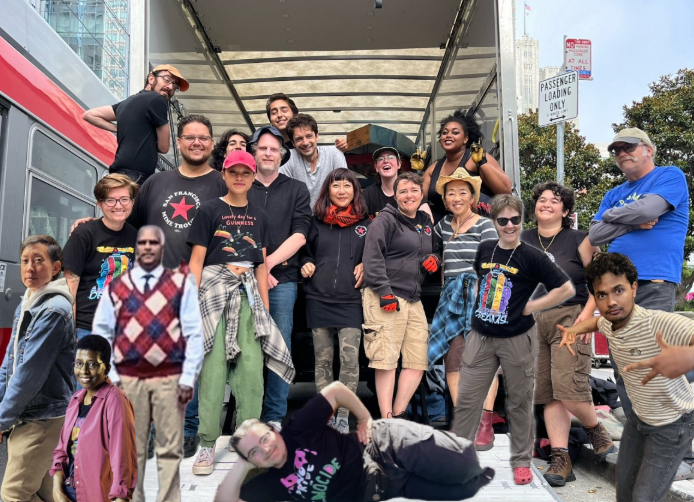
The whole Mime Troupe Crew for Summer 2024

Micki, Andre, and Taylor in the truck

Myself and another intern, Marisa, at SF Trans Pride Parade.

My last moment at the Mime Troupe, leaving for my flight to Ohio at the end of August 2024.

Cast, crew, and band members raise the Periaktos